When I started working in digital marketing, SEO was often treated as a mechanical task — add keywords, optimise a few pages, build links, and wait for rankings. Over time, through real campaigns, audits, e-commerce scaling, and countless training sessions, I realised something important:
SEO is not about pleasing search engines. It’s about earning trust.
Today, that trust is evaluated not only by Google, but also by answer engines and AI-driven platforms. This is why SEO can no longer exist in isolation. It now needs to work in alignment with AEO (Answer Engine Optimisation) and GEO (Generative Engine Optimisation).
In this blog, I’m sharing my understanding of AEO, GEO & SEO, based entirely on practical experience — what I’ve seen work, what I’ve seen fail, and how I explain these concepts to clients and learners in the real world.
What SEO Optimisation Means Today
At its core, SEO (Search Engine Optimisation) is about helping search engines clearly understand:
- What you’re offering
- Who it’s meant for
- Why you’re credible
In my experience, whenever a website struggled to grow, the problem was rarely “low backlinks” or “wrong keywords” alone. Most of the time, the site simply wasn’t clear enough — in content, structure, or intent.
Good SEO is not aggressive.
It’s aligned.
Why AEO Became Impossible to Ignore
While training students and reviewing real search behaviour, I noticed a clear shift. People were no longer typing short keywords; they were asking full questions.
That’s where AEO (Answer Engine Optimisation) comes in.
AEO focuses on making your content the best possible answer to a question.
For example, instead of just targeting on page seo, users now ask:
- what is on page seo and off page
- what is technical seo
- simple example of technical seo is
Whenever I structured content clearly — using simple explanations, logical headings, and direct answers — rankings improved naturally, and featured snippets followed.
That’s not a coincidence. That’s AEO at work.
GEO: Writing for AI, Not Just Algorithms
GEO (Generative Engine Optimisation) is something most people don’t consciously plan for — but they should.
AI tools don’t just rank pages; they read, summarise, and quote content. From my experience, content that performs well in GEO has three things:
- Context
- Clarity
- Credibility
When I started writing content that explained why something works — not just what works — I saw better long-term performance across platforms.
That’s when I realised SEO today isn’t only for search engines.
It’s also for AI engines that decide what information deserves visibility.
The Three Types of SEO (Explained the Way I Explain to Clients & Students)
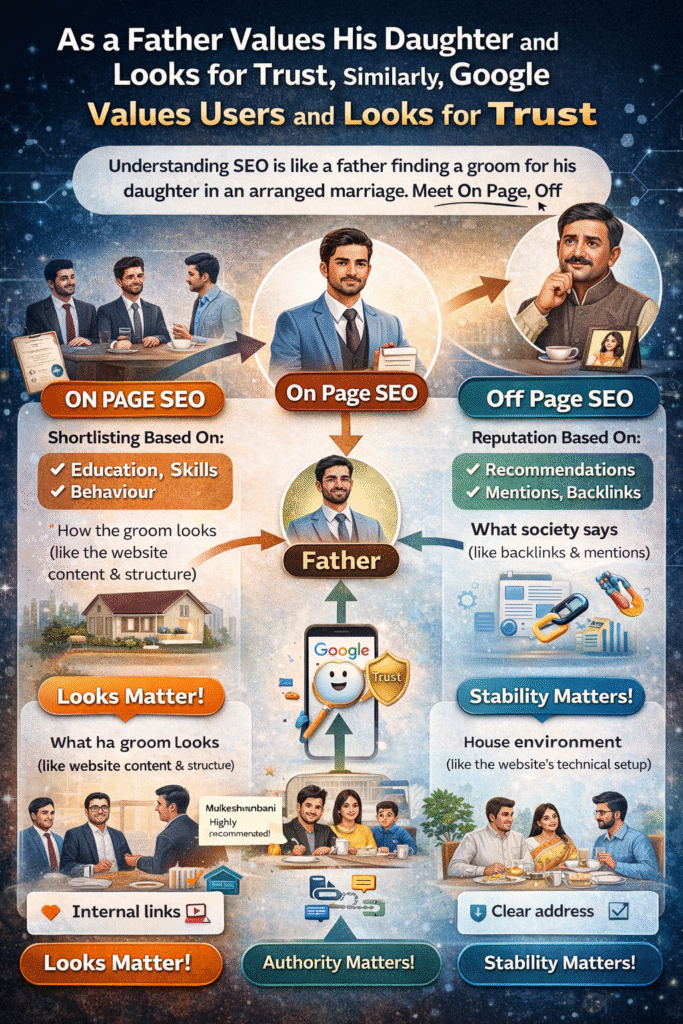
Whenever I teach SEO, I avoid jargon-heavy explanations. Instead, I use a real-life example almost everyone understands — an arranged marriage setup.
On Page SEO: First Impressions Matter
What On Page SEO Looks Like in Real Life
On page SEO is everything you control directly on your website — content, structure, layout, and clarity.
In an arranged marriage scenario, this is the first meeting.
The father evaluates:
- Education
- Communication
- Behaviour
- Presentation
- House appearance
This is exactly how search engines evaluate a page.
From my audits, weak on page SEO usually means:
- Confusing content
- Poor structure
- No internal linking
- Mismatch between intent and information
That’s why I always insist on a solid on page seo checklist and a proper on page seo check before thinking about anything else.
Off Page SEO: Reputation Changes Everything
If on page SEO is who you are, off page SEO is what the world says about you.
This becomes obvious in marriage discussions too.
If someone like Mukesh Ambani recommends the groom, trust skyrockets instantly.
If the same groom is referred by a gambler or unreliable person, doubts arise immediately — even if the groom looks good on paper.
This is exactly how backlinks work.
Over the years, I’ve seen websites with average on page SEO outperform better-looking sites simply because their off page authority was stronger and cleaner.
Technical SEO: The Foundation Nobody Notices (Until It Breaks)
What Technical SEO Really Means
Technical SEO is not flashy. Most users never notice it — until something goes wrong.
In our marriage example, technical SEO is the house infrastructure:
- Is it safe?
- Is it stable?
- Is it functional long-term?
A simple example of technical seo is:
- Fast loading pages = electricity & water
- Internal linking = rooms connected properly
- Clean URLs = proper house address
- No broken links = doors that open smoothly
Whenever I run a technical seo audit, I treat it like a house inspection. No assumptions. Only data.
Why Internal Linking Matters More Than People Think
I often explain internal linking as how the family lives together.
Strong internal links:
- Help search engines understand relationships
- Distribute authority
- Improve user journey
Many sites I’ve audited had good content but poor internal connectivity — and that alone was holding them back.
What SEO Has Taught Me Over Time
After working on live projects, running ads alongside SEO, and mentoring marketers, one thing is clear to me:
SEO only works when:
- On page SEO builds clarity
- Off page SEO builds credibility
- Technical SEO builds stability
Ignore one, and growth becomes unpredictable.
Final Thoughts (From My Experience)
SEO today is not a trick.
It’s not a hack.
It’s not a shortcut.
It’s a system built on clarity, trust, and consistency.
Whether I’m helping a brand grow, scaling an e-commerce campaign, or teaching students, my approach remains the same — focus on intent, structure, and long-term value.
When you stop trying to impress algorithms and start solving real problems clearly, rankings eventually follow.
That’s not theory.
That’s experience.